
Publications
Cosmopolitanism in Urban Spaces: The Case of Kuzguncuk and Its Hybrid Historic Environment in Istanbul
Abstract: Kuzguncuk, a historic neighborhood in the Asian (Anatolian) part of Istanbul, Turkey, serves as an exemplary case study to identify the complicated relationship between urban tradition and cosmopolitanism. The unique architectural heritage of Kuzguncuk is characterized by a variety of religious buildings, including two synagogues, two Greek Orthodox churches, an Armenian church and a mosque, all located in the immediate vicinity. The presence of different residential buildings built by people from various backgrounds also emphasizes the multicultural heritage that has shaped the urban fabric of Kuzguncuk. This spatial arrangement is not only an example of the historical cosmopolitanism of the area but also identifies the characteristics and sustainability of cosmopolitan architecture. The current situation in the area demonstrates the possible approaches and strategies which can be used for the sustainability of cosmopolitan architecture even though the cosmopolitan nature of the society has decreased over time. This article looks at the changing cosmopolitan character of Kuzguncuk, focusing on how the multi-ethnic harmony and their representative architectural coexistence have evolved over time and examines the impact on today’s urban space.
Reference to the paper: Doğan, Huriye Armağan, Omid Ebrahimbaysalami, and Xiang Ren. 2025. “Cosmopolitanism in Urban Spaces: The Case of Kuzguncuk and Its Hybrid Historic Environment in Istanbul.” Traditional Dwellings and Settlements Working Paper Series 347: 48–64.
Heritage in Transition: Vernacular Architectural Patterns in Rural Iran
Abstract: The transition from vernacular architectural patterns to current architecture in rural Iran has led to various socio-cultural and environmental problems in the last decade. This study explores the nature of this transition, which has been overlooked in the studies of vernacular architecture in Iran. Furthermore, this article contributes to the ongoing academic debate on the decline and transformation of vernacular architectural patterns in the context of modernization. It analyzes the forces behind the decline and rise of vernacular settlements in a case study area, the Salami region of the Khaf district in Iran’s Khorasan Razavi province, by exploring how it is possible to reinterpret vernacular architectural patterns in the context of current architecture to utilize the new developments in rural Iran not as an obstacle but as an opportunity for improvement. To this end, this article explores vernacular architectural patterns in a case study area in Iran, supported by socio-cultural aspects and the environmental conditions of the region. This study conducts architectural and anthropological fieldwork on three vernacular houses in a case study area and uses participant observation and informal interview methods to understand the people and their interaction with their built environment. The findings of this article thus contradict previous studies on learning from vernacular architecture by shedding light on vernacular architecture in Iran as a system by demonstrating the inextricable links between different vernacular architectural patterns. Therefore, this study argues that to draw lessons from vernacular architectural patterns for current architecture in rural Iran, it is necessary to limit its communication concerning people’s contemporary needs but not to neglect this communication completely.
Reference to the paper: Ebrahimbaysalami, Omid, and Xiang Ren. 2024. “Heritage in Transition: Vernacular Architectural Patterns in Rural Iran” Heritage 7, no. 7: 3393-3416. https://doi.org/10.3390/heritage7070160
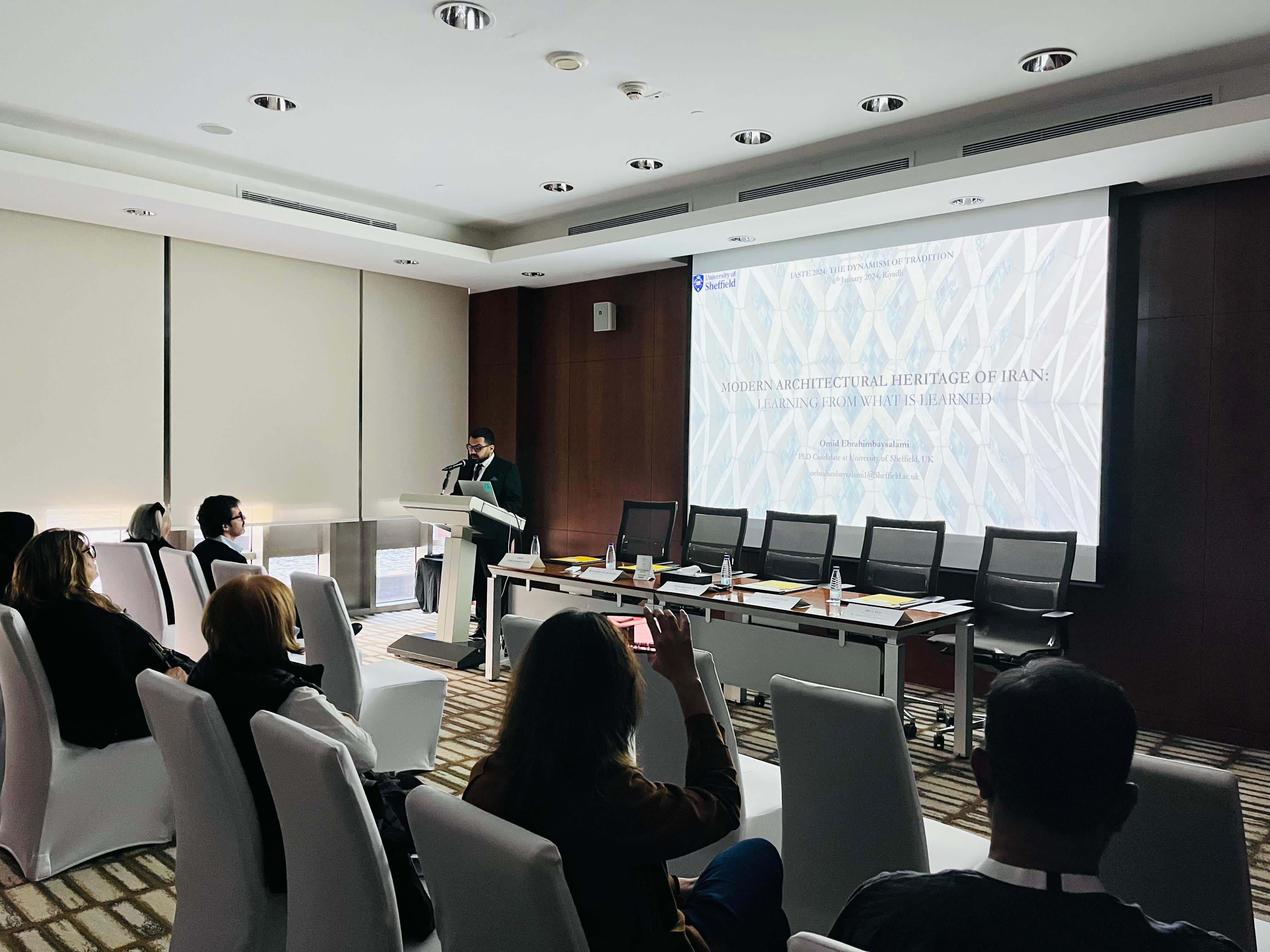
Modern Architectural Heritage of Iran: Learning from What is Learned. 2024
Abstract: Since the 20th century, with the initiation of the Modern Movement in the West, architecture in many parts of the world, especially in developing countries like Iran, has been significantly influenced. In Iran, this phenomenon began with the arrival of European architects and the return of Iranian architects educated abroad, accompanied by significant political, social, and cultural developments. This choice of development resulted in urban changes and the construction of many modern-style buildings from 1920 to 1980. However, this modern architectural movement opened new challenges for Iranian architects and researchers to connect the past to this imported way of development, mainly to answer to the new socio-cultural demands and preserve the Iranian architectural identity. Accordingly, the development of modern architecture in Iran enjoyed a trend of changes that formed a chain of different architectural styles. This architectural movement found a unique character by learning from Iran’s traditional and vernacular architecture. This style is unlike other modern styles worldwide and created a unique characteristic by utilizing new materials besides the traditional master ships that were a big deal during the time, managed by the academic architects and traditional masters. Thus, valuable buildings in the modern architectural history of Iran emerged that struggled to represent the connection between modern movements and the vernacular and traditional traditions to revitalize Iranian architectural identity and values. On the other hand, during this time, most of the consideration on architecture was focused on thorough public and governmental buildings by architects and authorities. So, the modern movement’s impacts on other buildings, especially residential buildings, were less considered. The result of this less consideration has been highlighted in the last decades that caused blind imitations of prepared architectural forms, mainly considered the structural part of buildings dominated by modern materials (steel and concrete). This phenomenon has accelerated in Iran’s new cities and rural areas, leading to identity lessness, which has been highlighted as one of the most critical challenges for Iranian architects and authorities. In order to address this problem in this research, the “Modern Architectural Heritages” of Iran will be investigated as they were the primary consideration from the time authorities and practitioners to revive the Iranian architectural identity. Thus, this question will be considered how and to what extent has Iran’s modern architectural heritage revived Iranian architectural identity? By answering this question, this research could ease the identity lessness challenge through a new discourse by learning from Iran’s “Modern Architectural Heritages” to recommend indicators that could revive Iranian architectural identity in the present and immediate future. This research aims to consider the “Modern Architectural Heritage” from a new lens that could highlight the importance of learning from these buildings rather than considering them just for conservation and preservation. In order to achieve the aim of this research, the case study methodology using triangulated methods (interview, observation, fieldwork) will guide this research through inductive generalization. This study could formulate recommendations of indicators that could revive Iranian architectural identity in the present and future.
Reference to the paper: Ebrahimbaysalami, Omid. “Modern Architectural Heritage of Iran: Learning from What is Learned. 2024. ” Traditional Dwellings and Settlements Working Paper Series 334: 37–56.
THE INFLUENCE OF TRADITIONAL ARCHITECTURE ON MODERN ARCHITECTURAL HERITAGE OF IRAN
Abstract: Iran has a rich architectural heritage that dates back thousands of years. Traditional Iranian architecture is characterized by a unique blend of aesthetics and practicality, which has influenced modern architecture in Iran. In this essay, we will explore the influence of traditional Iranian architecture on modern architectural heritage in Iran. One of the most significant influences of traditional Iranian architecture on modern architectural heritage in Iran is the use of natural materials. Traditional Iranian buildings were constructed using materials such as mud, clay, and straw. These materials were readily available and were used to create buildings that were well-insulated and could withstand the harsh climatic conditions in Iran. Modern architects in Iran have continued to use these materials, but they have also incorporated other materials such as concrete and steel. Another important influence of traditional Iranian architecture on modern architecture in Iran is the use of geometric patterns and motifs. Traditional Iranian buildings were adorned with intricate geometric patterns, which were often repeated throughout the building. These patterns were not only decorative but also served functional purposes, such as helping to cool the interior of the building.
Modern architects in Iran have continued to use these patterns in their designs, but they have also incorporated other motifs and designs that reflect modern aesthetics. Traditional Iranian architecture also influenced the layout and design of modern buildings in Iran. Traditional Iranian buildings were often arranged around a central courtyard, which served as the focal point of the building. Modern architects in Iran have continued to use this layout in their designs, but they have also incorporated other elements such as open floor plans and modular design. The use of natural light is another significant influence of traditional Iranian architecture on modern architectural heritage in Iran. Traditional Iranian buildings were designed to maximize natural light, and they often had large windows and skylights. Modern architects in Iran have continued to use natural light in their designs, but they have also incorporated other elements such as energy-efficient lighting and shading systems. In conclusion, the influence of traditional Iranian architecture on modern architectural heritage in Iran is significant. The use of natural materials, geometric patterns, water features, layout and design, and natural light are just a few examples of how traditional Iranian architecture has influenced modern architecture in Iran. Modern architects in Iran have continued to incorporate these elements into their designs, but they have also added their own unique twist to create a modern architectural heritage that is both innovative and respectful of Iran’s rich architectural heritage.
Reference to the paper: Rahbar, Parnian, and Omid Ebrahimbaysalami. 2024. “The Influence of Traditional Iranian Architecture Heritage of Iran.” Traditional Dwellings and Settlements Working Paper Series 326: 95–109.
REVIVAL OF TRADITION IN CONTEMPORARY ARCHITECTURE-A CASE STUDY IN IRAN
Abstract: Due to rapid technological and industrial progress, vernacular architecture can no longer meet the demands of new generations. As a result, it is increasingly being replaced by inaccurate modern-contemporary methods, especially in developing countries such as Iran, without considering the region’s unique traditions and social and environmental patterns. This study explores the reasons for this phenomenon using an anthropological approach in a case study area of Iran’s Khorasan Razavi province to address this problem. It recommends a new idea, the architectural sub-pattern, to revive confidence in vernacular architecture and connect the past with the present and future of architecture.
Reference to the paper: Ebrahimbaysalami, Omid. 2022. “Revival of Tradition in Contemporary Architecture (Sub-Pattern Hypothesis in Architecture-A Case Study in Iran.” Traditional Dwellings and Settlements Working Paper Series 342: 34–50.