
Activities
Place/Displacement: Micro-Narratives” workshop, funded by the French Embassy in the UK, 2021
In 2021, I participated in Place/Displacement: Micro-Narratives, an international workshop organised in collaboration between the University of Sheffield School of Architecture and ENSA Paris-La Villette, with support from the French Embassy in the UK. The workshop examined migration, displacement, place, and representation from an architectural perspective, deepening my interest in research-led practice, critical storytelling, and the role of architecture in addressing social and humanitarian issues.
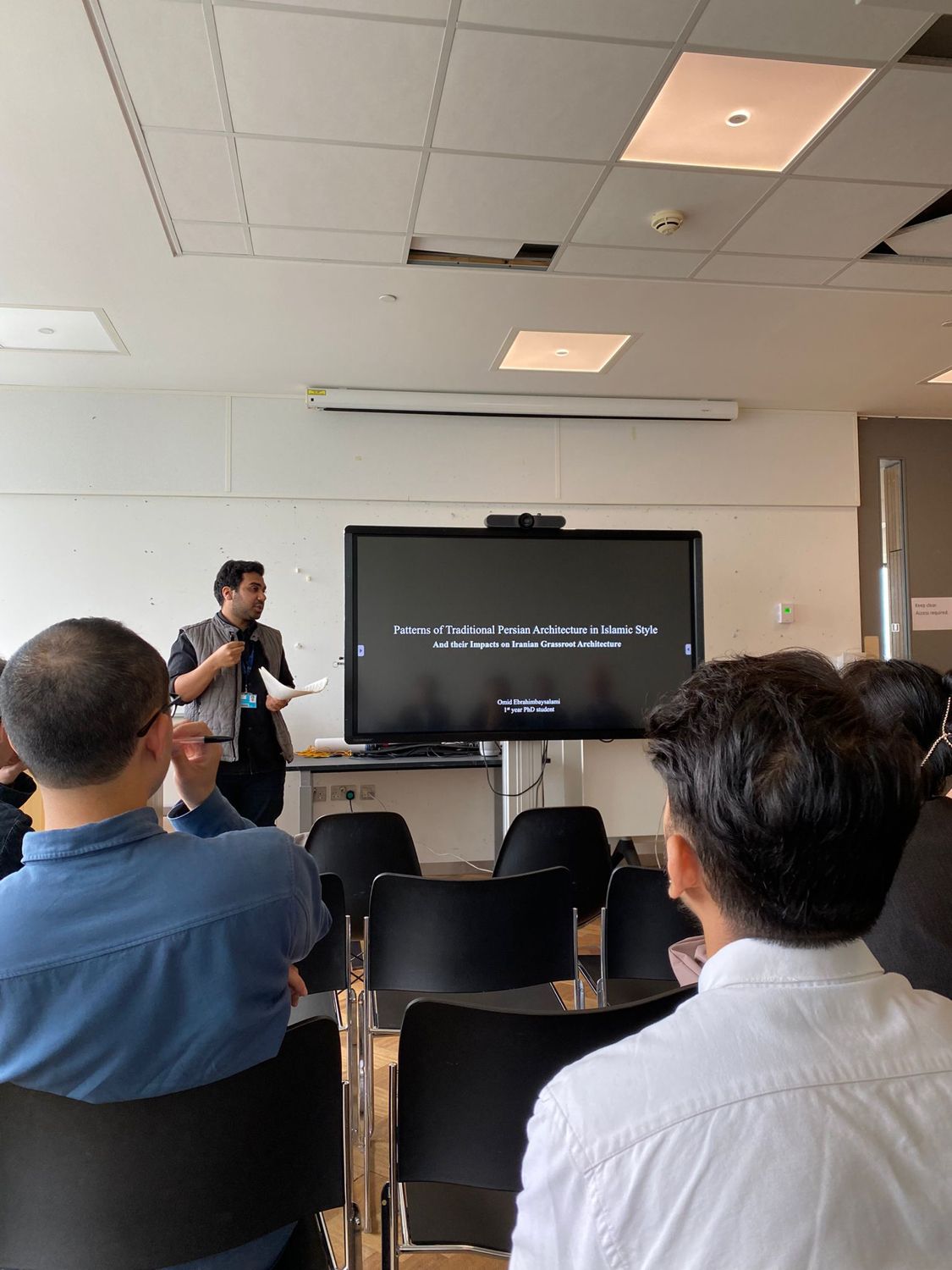
East-West Seminar at the University of Sheffield, 2022
Traditional Persian Islamic architecture is more than a historic building style; it is a cultural and visual language that has shaped Iranian identity for centuries. Evident in courtyards, arches, domes, geometric order, and decorative detail, it unites beauty, function, climate sensitivity, and spiritual meaning. Its influence extends into Iranian vernacular architecture, where everyday buildings adopt principles such as privacy, natural ventilation, and balanced proportions, demonstrating how these enduring design values became part of local architectural life and continue to inform discussions of heritage and identity.
Sustainable Living Environments and Cultures of Place Symposium at the University of Huddersfield, 2022
Presented at the Sustainable Living Environments and Cultures of Place Symposium in collaboration with Xiang Ren, Xiaolu Wang, and Abhishek Bhutoria, the group paper The Living Traditions of Sustainable Living: Learning from Vernacular Architecture and Settlements in Underrepresented Asian Geographies examined vernacular architecture across Asian contexts. This contribution focused on the Salami region in Khorasan Razavi Province, Iran, analysing its architectural patterns and the relationship between traditional and contemporary building practices. The study considered how local architecture embodies climate-responsive design, material adaptation, and everyday cultural practices, while also assessing the extent to which contemporary architecture in the region sustains, transforms, or departs from inherited vernacular principles.
IASTE Conference at the National University of Singapore, 2022
Presented at the conference Rupture and Tradition: Disruption, Continuity, Repercussions, the paper Revival of Tradition in Contemporary Architecture: A Case Study in Iran examined the tension between rapid modernisation and the continuity of local architectural traditions. Focusing on Iran, the study explored how vernacular architecture has been increasingly displaced by modern construction methods, which often respond inadequately to regional culture, environmental conditions, and social patterns. Using an anthropological approach and a case study from Khorasan Razavi Province, the research analysed the causes and consequences of this transformation, arguing that vernacular architecture retains valuable social, climatic, and spatial principles for contemporary design. It also introduced the concept of the architectural sub-pattern as a framework for reinterpreting traditional forms and reconnecting contemporary architecture with cultural continuity, environmental intelligence, and a stronger sense of place.
Grantham Center Symposium at the University of Sheffield, 2022
The poster In Search of Accurate Contemporary Architecture in Iran examined a key issue in rural Iranian architecture: the growing disconnect between contemporary building practices and vernacular patterns historically shaped by climate, materials, culture, and daily life. Rather than rejecting contemporary architecture outright, it argued that many recent developments have neglected the environmental intelligence and socio-cultural logic embedded in traditional forms, resulting in buildings that are less rooted in place and identity. The poster therefore called for a more grounded understanding of contemporary architecture in Iran, one that balances present-day needs with the critical reinterpretation of inherited rural architectural knowledge.
Poster Competition at the University of Sheffield, 2023
The poster examines the reinterpretation of Iranian architectural identity during the emergence of modern architecture in Iran from 1920 to 1980. Influenced by Western modern movements, this period saw significant urban transformation and the widespread construction of modern-style buildings, while also raising the question of how architectural modernisation could engage with Iran’s established traditions and cultural identity. The study highlights that architectural attention focused mainly on major public and governmental buildings, with less consideration given to the broader effects of modernism on other building types. By analysing this modern architectural heritage, the poster explores how Iranian identity was reimagined through references to traditional and vernacular architecture, and reflects on the implications of this process for current debates on architectural identity and future practice.
SCP Seminar at the University of Sheffield, 2023
The presentation, Modern Architectural Heritage of Iran: Approaches to the Revival of Iranian Architectural Identity, examined how distinguishing between modern and contemporary architecture in Iran clarifies different approaches to preserving and renewing architectural identity. It placed modern architecture within the period of rapid modernisation, particularly from the early twentieth century through the Pahlavi era, when new materials, professional practices, and international design ideas reshaped the built environment. In contrast, it understood contemporary architecture as a broader and more diverse field shaped by debates on authenticity, regionalism, cultural memory, and the relationship between global influence and local tradition. From this perspective, the revival of Iranian architectural identity was presented not as a simple return to historical forms, but as a critical reinterpretation of vernacular, Persian, and Islamic spatial principles within modern and contemporary architectural practice.
Manifesto at the University of Sheffield, 2023
The 2023 Manifesto PhD Conference, organised at the University of Sheffield in collaboration with two other postgraduate research representatives from the Sheffield School of Architecture, was a two-day internal doctoral research event held on 26–27 June 2023 in the Arts Tower. Bringing together PhD researchers in Architecture, Landscape, and Urban Design, the conference provided a platform for presenting ongoing research, fostering dialogue, and encouraging critical exchange within the postgraduate research community. The programme featured panel presentations, methodological and writing workshops, 16 PGR presenters, three keynote speakers, and two workshop leaders, contributing to an interdisciplinary forum that enhanced the visibility of doctoral research and supported meaningful academic engagement within the school.
COP28 in Dubai, 2023
Attendance at COP28 in Dubai as an observer and Grantham Centre scholar from the University of Sheffield enabled engagement with one of the most significant international platforms for climate dialogue and policy discussion. The conference provided direct insight into key debates on climate action, sustainability, adaptation, and the built environment, and highlighted how governments, researchers, practitioners, and civil society organisations respond to urgent global challenges. This experience deepened understanding of the relationship between climate policy, research, and practice at the international level, and reinforced the importance of interdisciplinary collaboration in addressing climate change. It also broadened perspective on the global climate agenda and its relevance to research and practice focused on sustainability, resilience, and environmental responsibility.
East-West Seminar at the University of Sheffield, 2024
The seminar, Modern Architectural Heritage of Iran: Dynamic Interaction between Modernity and Tradition, brought together scholars and researchers to examine the complex relationship between architectural modernity and historical continuity in Iran. With contributions from distinguished Iranian professors, including Dr Ali Madanipour, Dr Ali Kiafar, and Dr Vahid Ghobadian, as well as invited researchers, the event provided a platform to discuss how Iranian architecture has engaged with modern ideas while remaining connected to its cultural, historical, and aesthetic foundations. A related presentation, Modern Architectural Heritage of Iran: Interaction between Modernity and Tradition, focused on the Shahyad Monument, now known as the Azadi Tower, as a case study exploring the synthesis of modern design and traditional Iranian forms. Using this example, the seminar highlighted Iran’s modern architectural heritage as the result of a dynamic exchange between innovation and memory, rather than a simple rupture between past and present.
IASTE Conference in Riyadh, 2024
Presented at the conference The Dynamism of Tradition, the paper Modern Architectural Heritage of Iran: Learning from What Is Learned examined the development of modern architecture in Iran from the 1920s to the 1980s, shaped by the combined influence of the Modern Movement and broader political, social, and cultural transformations. Rather than viewing this history as a straightforward importation of Western architecture, the study argued that Iranian modern architecture evolved through successive efforts to reconnect modern design with traditional and vernacular forms, resulting in a distinctive architectural character. Focusing on the uneven effects of this process, particularly the prioritisation of major public buildings over residential and everyday environments, the research considered how later context-insensitive development contributed to the weakening of architectural identity. Through case studies supported by interviews, observation, and fieldwork, the paper positioned Iran’s modern architectural heritage as both an object of study and a source of lessons for contemporary practice, proposing that it can inform new indicators for reviving Iranian architectural identity and strengthening the relationship between tradition, modernity, and future architectural development.
On-site assistance of “The digital preservation of the Padley Mill as both heritage and knowledge” research article, 2024.
Contributed as an on-site assistant to the research paper “The Digital Preservation of the Padley Mill as Both Heritage and Knowledge” by Xiang Ren and Huriye Armağan Doğan, a project focused on digitally preserving Padley Mill in Grindleford, Derbyshire, using 3D LiDAR scanning and photogrammetry. The work included field-based heritage documentation, data collection, and the creation of accurate digital records to support the preservation and understanding of the site. This contribution was part of a collaborative academic effort linking architectural heritage, historical research, and digital technology, and was acknowledged in the paper.
East-West 30th Anniversary Symposium at the University of Sheffield, 2025.
Contributed as a PhD volunteer to the East-West 30th Anniversary Symposium at the University of Sheffield in 2025, an international event organised to mark three decades of East-West Studies in Architecture and Landscape. The symposium brought together scholars and speakers from architecture, landscape, and urbanism, providing a platform for interdisciplinary discussion, academic exchange, and institutional collaboration on the future of East-West thinking at a planetary scale. Supporting the delivery of the event was part of ongoing engagement with research culture, collaborative scholarship, and the organisation of international academic events.
East-West Seminar at the University of Sheffield, 2026.
In my presentation, I discussed the architectural transformation of Iran before the Islamic Revolution, focusing on the development of modern architecture from the late Qajar period through the First and Second Pahlavi eras. I examined how traditional Iranian architectural elements gradually changed under the influence of modernisation, new construction methods, Western architectural ideas, and state-led urban development. The presentation explored how buildings, public spaces, and the city of Tehran began to reflect a new modern identity while still retaining elements of Iran’s historical and cultural heritage.